Phlip — an AI-native marketplace operator.
AI-native marketplace arbitrage. Your personal AI broker for marketplace reselling — automating the full arbitrage pipeline for the ~50 million Americans who resell as side income or full-time work. Shipping as a one-engineer-plus-AI-agent-stack company; twelve weeks of focused build produced the marketing site, the complete investor data room, and a substantial portion of the broker product itself. INNOV8 is on retainer.

Three surfaces, one operator
INNOV8 is currently on retainer to Phlip — an AI-native platform that automates the full arbitrage pipeline for the roughly fifty million Americans who resell as side income or full-time work. The agency context: Mike took the founder seat, and INNOV8 became the studio of record for the build. The execution shape: one engineer plus the Anthropic Claude agent stack running the work that historically required a full team.
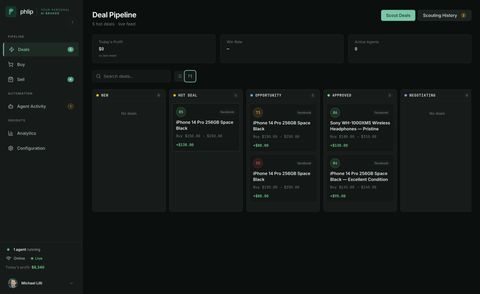
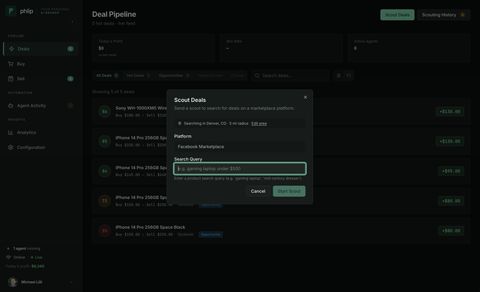
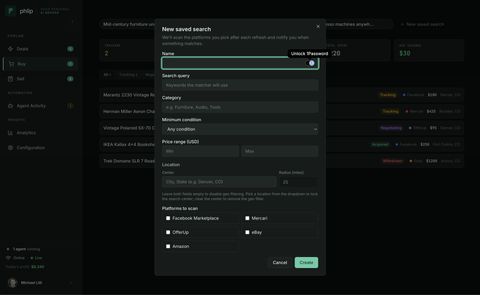
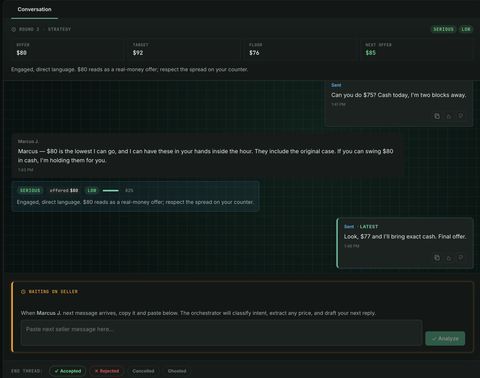
The pain point is structural. A serious reseller scans hundreds of listings across multiple marketplaces every day — Facebook Marketplace, eBay, Mercari, OfferUp, and the rest — hours of pure scanning before a single item gets purchased. The work is fragmented across platform-specific dashboards, spreadsheets, and tribal knowledge; the tooling industry hasn’t built for it. Phlip eats that scanning subtask whole, surfacing the arbitrage opportunities the operator would have found manually — faster, more comprehensively, and with the margin math already done.
Twelve weeks of focused build through March, April, and May of 2026 produced the marketing site at phlip.app, the complete investor data room, and a substantial portion of the broker product itself — the kind of scope that historically required at least twelve specialists across design, frontend, backend, DevOps, and QA, over a six-to-nine-month build cycle. That compression isn’t a productivity trick. It’s a structural change in what a single operator can ship when the AI-agent stack is doing the multiplier work and three decades of operator instinct is doing the steering.
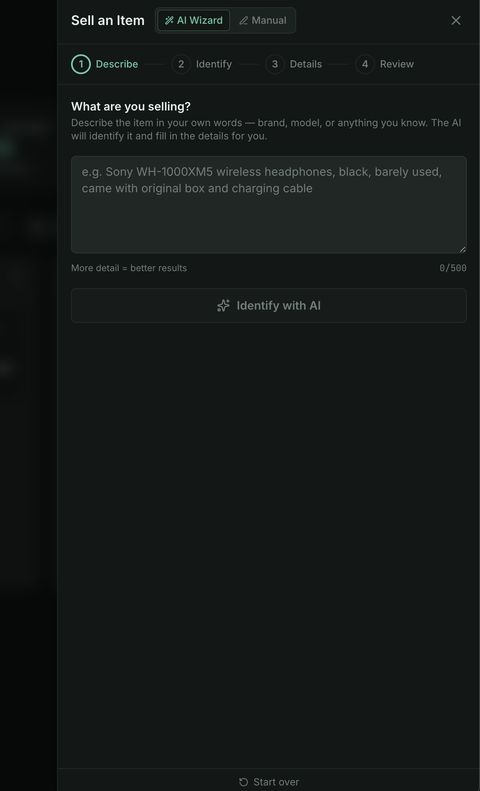
The May 2026 architecture refresh shipped three load-bearing investments that materially differentiate Phlip from single-vendor AI-wrapper competitors. First, per-task LLM routing across multiple providers: every call site routes through a task-aware decision layer that picks the cost-optimal model from Anthropic, OpenAI, Google, and DeepSeek across each provider’s available model tiers. A per-tenant provider allowlist gates which providers a tenant’s data can touch — sensitive surfaces stay on Anthropic unconditionally; non-sensitive high-volume work routes to lower-cost providers. An eval harness re-runs whenever a new frontier model lands, so the routing tables update without architectural surgery.
Second, multi-pass critic-refine pipelines on the highest-ROI premium surfaces — the user-facing places where quality translates most directly to operator outcomes. These pipelines run generator → critic → refiner, deliberately spending more LLM cost per call because the quality delta is load-bearing. Internal-only outputs stay single-pass — Phlip doesn’t double-pay where the asymmetry doesn’t earn it. Single-vendor wrappers can’t make this surface-specific quality-versus-cost tradeoff because their cost model can’t afford to.
Third, prompt-cache discipline as a structural cost lever. Anthropic’s 90% input-cache discount and OpenAI’s 50% require disciplined system-prompt architecture — the schema, few-shot examples, and rubric have to stay stable across calls to qualify for cache credit. Wrappers that inline tenant-specific context into the system prompt forfeit the discount, which doubles their effective per-call cost. Every Phlip prompt path is structured to qualify for the maximum cache credit the provider offers, and the cache hit rate improves per tenant-month as more of each tenant’s corpus gets schema-fitted into the cacheable prefix. That compounds.
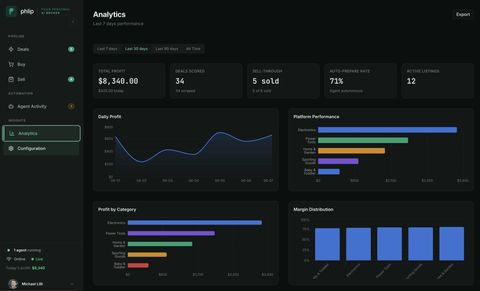
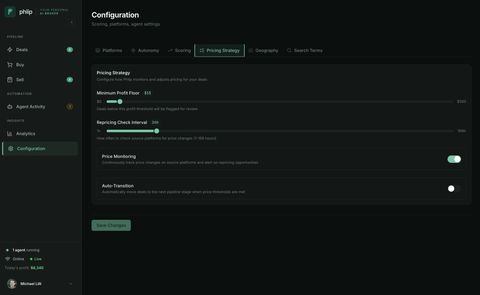
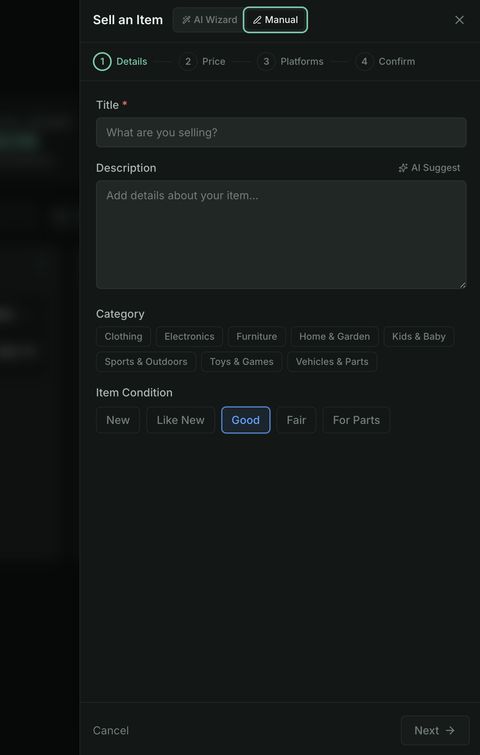
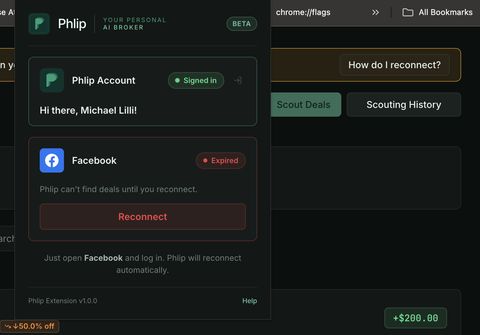
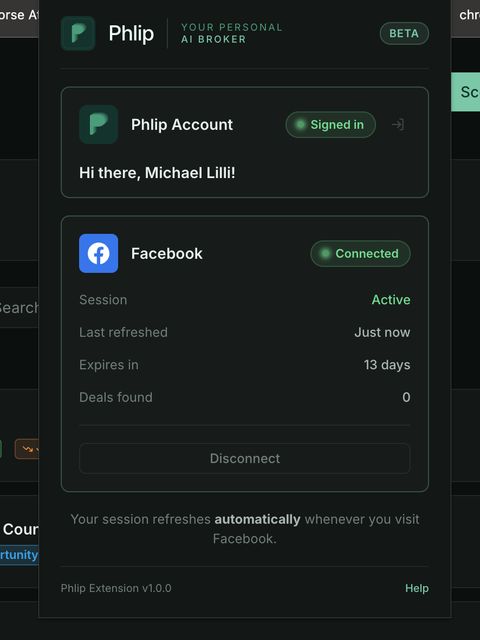
The broker-app stack. Phlip ships as a pnpm-monorepo with seven applications in production: a React 19 + Vite web app, an Express 5 API, a multi-marketplace scouting service, a Chrome extension, a multi-tenant Telegram bot, a custom-rendered Auth0 Universal Login surface, and a workflow-engine package built on XState v5 state machines. The web app enforces a strict layered architecture with import-rule enforcement — boundaries live in the linter, not in convention. Redux Toolkit + RTK Query manages derived state with Auth0 as the source of truth for identity; shadcn/ui + Tailwind CSS 4 drives the UI; react-hook-form + Zod handles every form input and every JSONB column write at runtime. The data layer is Postgres on Supabase via Prisma, with append-only audit tables wrapped in a Prisma extension that rejects UPDATE/DELETE/upsert at the ORM layer — historical truth is enforced in code, not in convention. Background jobs run on BullMQ over Redis (Upstash). The runtime is multi-vendor: compute on Railway, Postgres on Supabase, Redis on Upstash, with Cloudflare handling DNS, CDN, and TLS termination across every public surface. The web app + Auth0 ACUL screens ship as static assets on Cloudflare Pages and R2.
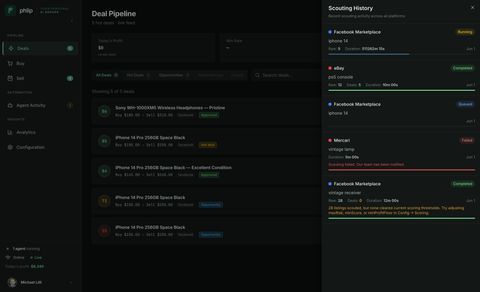
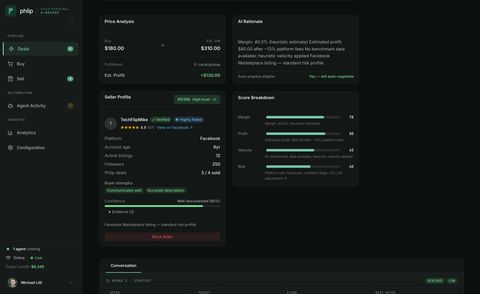
Two pieces of engineering that deliver outsized leverage. First, the multi-marketplace scouting service. Each marketplace Phlip operates against has its own surface, its own session model, and its own pacing requirements — a single shared abstraction wouldn’t have survived contact with production traffic. Per-platform adapters handle the surface-specific work; a shared scheduling, session, and quota layer keeps the service inside each marketplace’s published limits at the volumes a serious reseller’s pipeline demands. This is the engineering that determines whether the product scales cleanly from one operator’s nightly run to many concurrent operators without operational fragility. Second, the seller-side risk-scoring framework — a multi-version pipeline running in production. A hand-tuned version emits a banded score for the operator-facing UI; a learned-from-outcomes version trained on realized deal outcomes is the model whose score wins when it exists, with the hand-tuned narrative attaching as the human-readable rationale layer (the two versions have different calibration goals). Scores cache atomically because the frontend can’t bind partial state without surfacing a fresh score next to stale evidence. The buyer-side counterpart is the next workstream.
Where we are right now: shipping. Currently raising the Series Seed round (Q2 2026). The marketing site shows the public surface; the data room is investor-eyes-only. The same operator instinct that ran the Acura Build & Price configurator for seven production years and the Honda automobiles.com BAP into six-plus production years is now running a founder-stage AI-native marketplace as employee zero, with the agent stack as the multiplier.

Phlip is mid-build.
The next chapter is still open — selectively.
INNOV8 takes on a small number of engagements at a time. That’s by design.