Electronic Arts — ea.com, Exodus Engine, and Origin
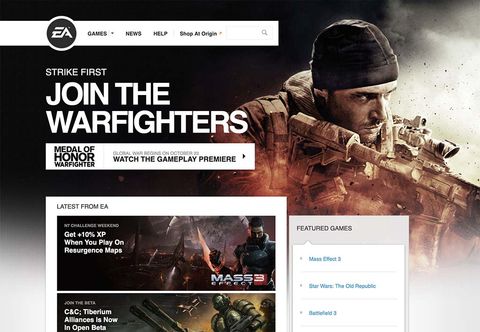
Four products, four years, one direct client — the engagement INNOV8 was founded to serve. From September 2009 through September 2013, Electronic Arts contracted INNOV8 directly to architect and build the frontend for ea.com's full redesign, the Exodus Template System (a skinnable microsite engine that launched 11+ game titles on Digital River), origin.com, and the native Origin desktop client — EA's answer to Steam. The founding direct-client relationship that put INNOV8 on the map.

The engagement
September 2009. INNOV8 Interactive is days old — Mike Lilli has just formed the company and brought on its first developer. The client waiting on the other side: Electronic Arts, the world’s largest gaming company, with ea.com serving tens of millions of players globally.
The EA relationship ran from September 2009 through September 2013 — four years, four distinct frontend products, one direct Master Services Agreement, no agency of record as intermediary. EA contracted INNOV8 directly, vetted it quarterly as a vendor, and trusted it with four of the most architecturally varied frontend problems in its portfolio: the full ea.com redesign, a skinnable microsite engine and 11+ game launch sites on Digital River, origin.com, and the native Origin desktop client. Four years, four completely different engineering challenges, the same direct-client relationship across all of them.
How it started — and why it required forming a company
The introduction came through Jerimy Abner, Director of Engineering at EA, who had worked with Mike previously on the Acura Build & Price configurator. The Acura engagement produced the trust; Jerimy carried it to EA when the company needed a frontend partner for the ea.com redesign. When the project came together in September 2009, the scope was clear enough that a solo-contractor arrangement wasn’t the right shape — EA wanted a vendor.
Mike formed INNOV8 Interactive specifically for this engagement.
EA’s requirements were explicit: a real company with demonstrable headcount, non-EA work that proved it wasn’t a disguised employment relationship, and the operational infrastructure of an actual agency vendor. Mike met those requirements by building them. He hired his first developer and started the ea.com project as a two-person agency on day one.
EA’s quarterly vendor review process kept the discipline honest across the four-year tenure. Every quarter, INNOV8 had to demonstrate active work with clients other than EA and actual engineering headcount working under its banner. That gate wasn’t a burden — it was a forcing function that built the breadth of the practice while the EA anchor kept the revenue stable. By the engagement’s end INNOV8 had six engineers across its active project streams, had built a client roster that extended well beyond EA, and had crossed $1 million in annual revenue — the first time Mike had built an agency to that threshold since his Austin-era work in 1999 and 2000.
ea.com redesign (2009–2011)
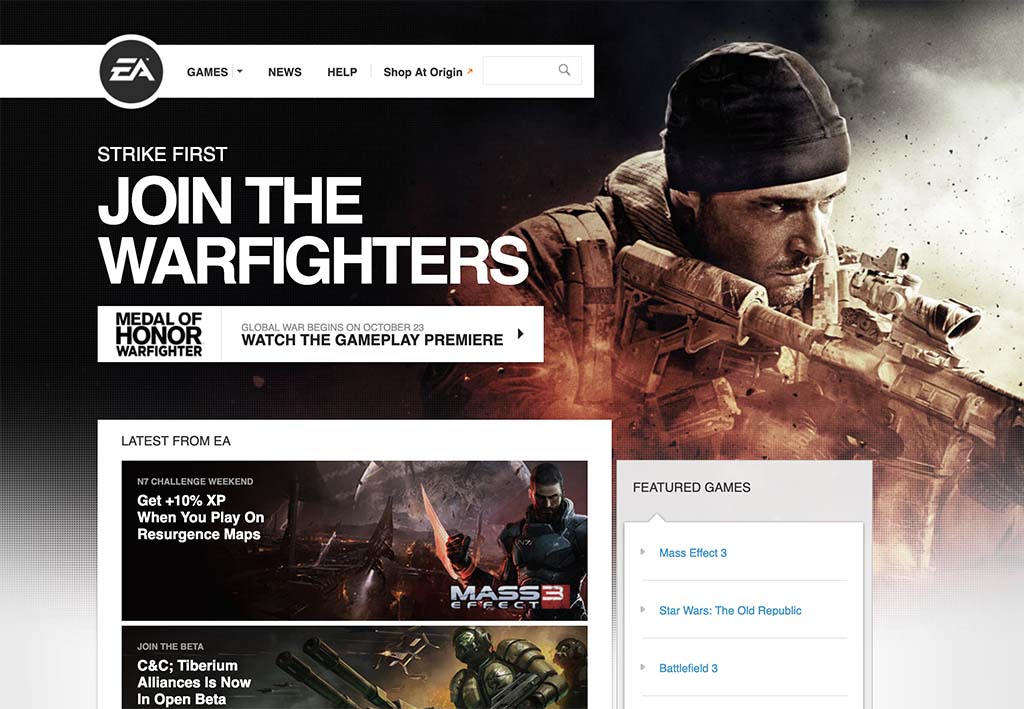
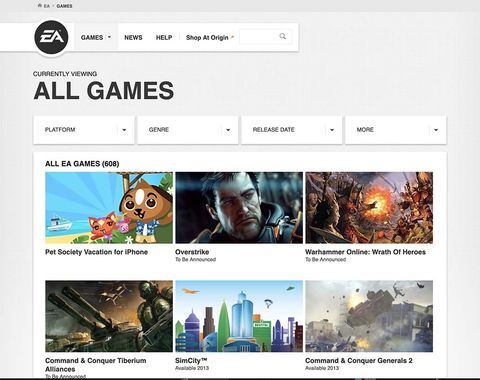
The first project was the largest in scope: a complete redesign of ea.com, the homepage and primary web surface for a company managing hundreds of active game titles and tens of millions of registered accounts.
The engineering approach
INNOV8’s scope was the entire frontend: a custom styleguide, a custom object-oriented component library, and the implementation of the redesign across ea.com. The stack was pure HTML, CSS, and JavaScript — no framework, in the era before React had stabilized or build-pipeline-normalized component tooling existed. The component library was built on custom OOP JavaScript patterns with components that integrated into the server-side data layer via custom HTML data attributes. EA’s backend engineers owned the server-side rendering; INNOV8’s library consumed that output and composed the UI on top of it, cleanly separated from the backend so new page types could be assembled by composing existing components without touching the core library.
That modularity was a design requirement, not an accident. At ea.com’s scale — the surface area of a major gaming company’s full web presence, with product pages, regional sites, and content types that proliferated continuously — a component architecture that required backend changes to add a new page type would have been operationally unsustainable.
The most technically demanding piece of the ea.com work was integrating Origin SSO — EA’s single sign-on authentication layer — across the redesigned site. Origin SSO served millions of registered EA users authenticating across a portfolio of properties. A Node.js backend layer mediated the authentication flow cleanly, keeping session state out of the component boundaries INNOV8’s architecture had established for the frontend layer.
The launch
The ea.com redesign launched in mid-2011. Mike was in EA Sports’ Vancouver headquarters for the overnight launch, in the war room alongside the company’s product and engineering leadership as the new site went live. The launch was clean.
INNOV8 doesn’t have post-launch performance metrics from the ea.com engagement — this was 2011, before the systematic performance benchmarking and real-user monitoring that characterizes modern web operations. What the engagement produced instead was EA’s trust, demonstrated by the three successive projects that followed under the same MSA.

Exodus Template System + game microsites (2010–2011)
Concurrent with the ea.com redesign, EA commissioned a separate project: a reusable, skinnable engine for the game microsites on its online store, which ran on Digital River — EA’s eCommerce backend at the time, later migrated to AEM.
The Exodus architecture
The Exodus Template System — the engine Mike architected — solved a specific structural problem: Digital River’s server-rendered HTML templates produced fixed markup that couldn’t be restyled to match each game title’s visual identity without modifying the underlying template. Modifying templates per-title at Digital River’s scale meant operational overhead that didn’t track to EA’s game launch cadence.
The solution was a custom JavaScript configuration schema layered on top of Digital River’s rendered HTML output. The schema governed three things:
- Content module arrangement — sections of the microsite could be reordered, shown, or hidden from configuration alone. No HTML changes required at the Digital River level.
- Interactive components — trailers, galleries, purchase flows, and custom UI widgets were declared in the configuration and activated at runtime by the engine.
- Visual identity — CSS hooked into the class names the JavaScript configuration layer applied to the markup. A complete game skin could be delivered by writing CSS and a configuration file, without touching any other layer of the stack.
Digital River handled the eCommerce backend — purchase flows, download delivery, license management. Exodus was the presentation layer that wrapped that backend output in each game’s visual identity. The architecture kept those concerns separated: the engine’s contract with Digital River was stable, and the skin contract with the CSS and configuration layer was flexible enough to accommodate any visual direction EA’s game teams wanted.
The microsite engagements
Individual game microsites were contracted as separate Statements of Work under the one MSA — one SOW per title. INNOV8 delivered 11 documented game microsites on the Exodus engine: Dragon Age Legends, Fight Night, Kingdoms of Amalur: Reckoning, Madden NFL 12, Monopoly Streets, NCAA Football 12, Microbot, Shadow of the Damned, The Sims, SSX Deadly Descents, and Tiger Woods PGA Tour 2011.
Mike architected the Exodus engine and then operated primarily as technical lead and quality director across the microsite SOWs — setting the architectural baseline upfront, overseeing the team’s implementation of each skin, and pitching in directly on the titles that required it. Every microsite shipped through his quality review before delivery.
origin.com (2011–2012)
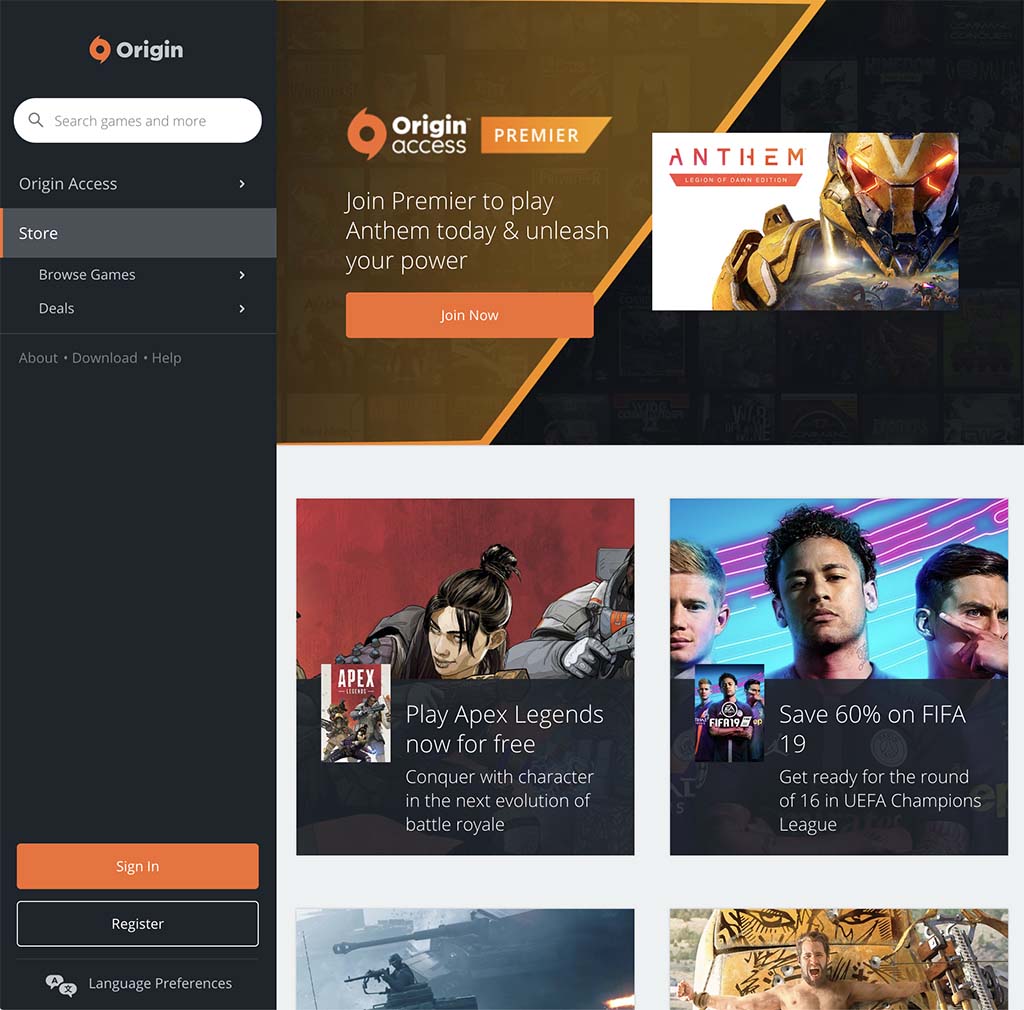
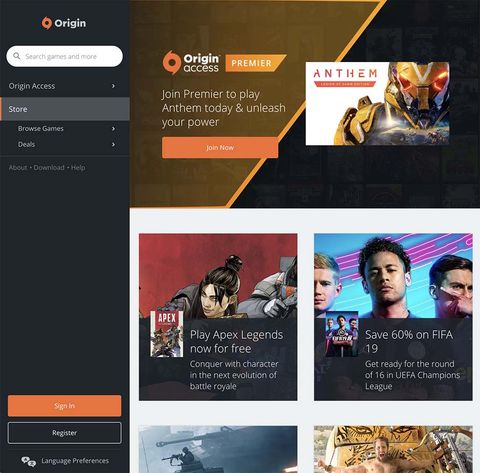
As the ea.com redesign was wrapping, EA’s Origin platform — its digital distribution service — needed a frontend engineering partner for a full origin.com redesign. A separate contract from the ea.com engagement, but a direct continuation of the EA relationship.
The architecture on origin.com differed from ea.com: a full C++ server-side stack backed the platform, with a Chromium webview serving as the frontend presentation layer. INNOV8’s scope was the complete frontend — every user-facing surface on origin.com, integrating against the backend infrastructure EA’s engineering team owned.
This was the first engagement where INNOV8 worked alongside Odopod, a San Francisco design agency that had become a preferred EA creative vendor. Odopod delivered the visual design; INNOV8 built the frontend against those designs. The collaboration continued into the Origin Client engagement that followed.
Origin Client (2013)
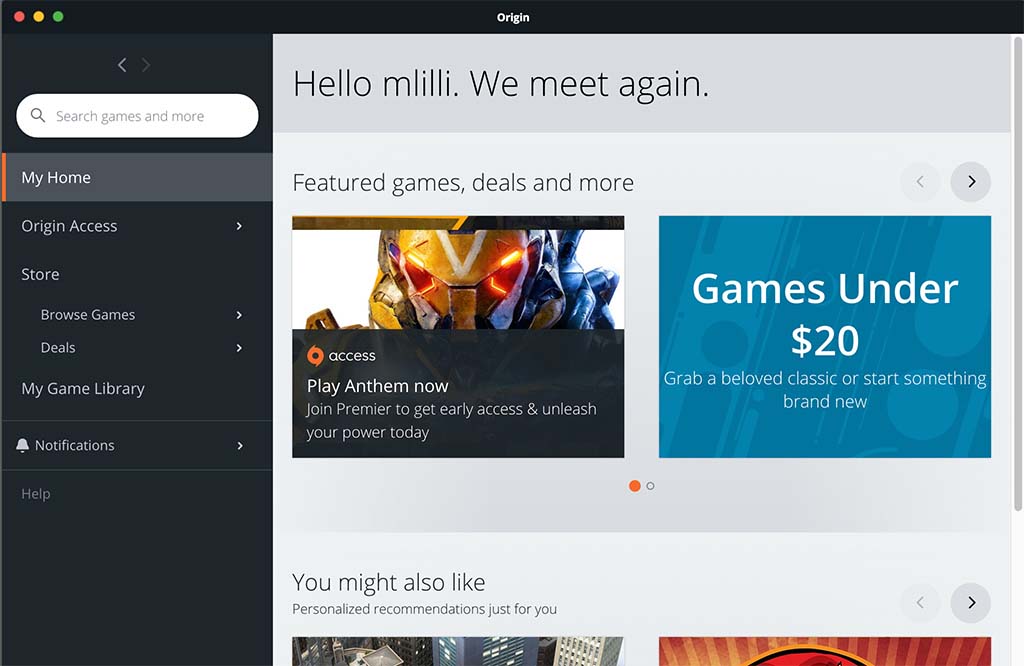
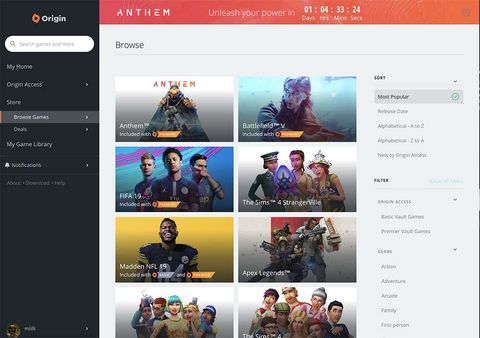
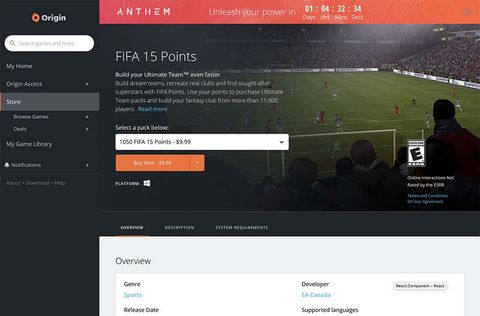
The final EA engagement, and the most architecturally distinctive of the four: the native Origin desktop client — EA’s direct competitor to Steam, built as the primary distribution platform for EA’s game catalog on Windows and Mac.
The architecture
The Origin Client was a native C++ application shell with an embedded Chromium webview rendering the entire user interface as HTML5. This pattern — native application as a thin shell around a web UI — let EA maintain a single frontend codebase across platforms while retaining native OS integration for file system access, game launching, and system-level events.
INNOV8’s scope was comprehensive:
- The entire UI layer — every screen and every surface in the client, from the storefront to the game library to the social features and settings panels.
- All UI components — the full component set, built in HTML5 and JavaScript within the Chromium rendering context.
- The C++↔JavaScript integration layer — the bridge between the native shell and the web UI.
The integration layer is worth unpacking. The Origin Client exposed C++ functions callable directly from JavaScript and used a message-passing interface for bidirectional communication between the native layer and the HTML/JS UI. Many of the real-time events — game download progress, friend activity, library updates, session state changes — arrived via socket connections in the native C++ layer and propagated into the JavaScript UI through the event bridge. From the frontend’s perspective, these events arrived as standard JavaScript events; the bridge handled the translation between the native transport and the web runtime.
One constraint inherent to the Chromium-in-native-shell architecture: the embedded Chromium version lagged the public browser release track, which meant certain CSS features available in contemporary browsers weren’t available in the Origin Client’s rendering context. The team navigated those constraints case by case, finding creative solutions rather than fighting the platform — a discipline that characterized the engagement’s daily texture.
Odopod again provided the visual design for the Origin Client. The structural model echoed Steam — storefront, game library, social layer, download management — built in EA’s own visual identity.
The engagement concluded in September 2013 with a phase handoff to EA’s internal Origin engineering team. INNOV8 delivered the architecture, the full component library, and the complete UI implementation, then handed the codebase to EA’s team to continue from.
Team: Mike led the Origin Client with two INNOV8 engineers integrated directly with EA’s Origin engineering team.
What the EA years meant
The EA tenure produced a specific kind of credential: not a single marquee metric, but four years of sustained direct-client trust across four completely different engineering problems. The quarterly vendor reviews, the expansion from one MSA into successive SOWs across distinct product surfaces, the architectural range — ea.com’s OOP component library, the Exodus engine’s configuration-schema-over-fixed-HTML pattern, origin.com’s C++ + Chromium stack, the Origin Client’s native-shell-around-a-webview inversion — these are the signals of a practice that adapts to the problem rather than templating the client to fit a preferred stack.
The revenue milestone the engagement crossed mattered personally as proof of what INNOV8 had become. The last time Mike had built an agency to seven figures annually was the Austin era of the late 1990s — Global Speed, then The Web Group, in the pre-crash frontier when Austin’s technology scene was assembling itself. Building back to that threshold, this time under a direct Fortune 100 MSA with a team he’d hired and vetted himself, was the signal that the INNOV8 bet had paid off.
The people lineage
Two threads from the EA years reach into the rest of the INNOV8 story.
Jerimy Abner — whose prior collaboration with Mike on the Acura Build & Price configurator opened the EA door — stayed in Mike’s professional orbit after the engagement ended. His LinkedIn recommendation, on the recommendations page, is one of the defining endorsements in the practice’s history. He coined a private shorthand within EA for work that met his standard; the label never made it to this page, but the standard it described is visible across every engagement documented here.
David Rolland — a VP at EA through much of the engagement’s run — left EA for Barnes & Noble and brought INNOV8 with him. The Nook Web Reader engagement followed directly: David Rolland trusted the work he’d seen across ea.com and the Origin engagements and carried that trust to his next role. The INNOV8 relationship traveled with him.
That forwarding motion — trust extending past the engagement, carrying into the next institution — is one of the defining patterns of how INNOV8 has operated across three decades. The Jerimy Abner thread runs from Acura to EA. The David Rolland thread runs from EA to Barnes & Noble. The relationship is the work; the work is what the relationship carries forward.





Have something worth building together?
INNOV8 is currently focused on Phlip — but selectively open to the right next chapter. If the work here resonates with what you're trying to build, get in touch.