TopLine Game Labs
Three products, one platform, one founding-team frontend org. From 2013 through early 2016 INNOV8 served as the founding-team frontend lead at TopLine Game Labs — a Cantor Ventures portfolio company that raised a $25M seed to build a mobile-first daily fantasy sports platform. The flagship product, DailyMVP, ran real-time contests for the NFL, NBA, MLB, NHL, and Liga MX with Tom Brady and Steve Nash starring in the 2014 launch campaign. The same engineering team also delivered FanNation — a white-label of the DailyMVP platform shipped under the Sports Illustrated brand — and TopLine Game Labs' own corporate marketing website.

The engagement
From September 2013 through January 2016, INNOV8 served as the founding-team frontend lead at TopLine Game Labs — a Cantor Ventures portfolio company building a mobile-first daily fantasy sports platform. The engagement carried three products under one engineering org: DailyMVP, the flagship daily fantasy sports product; FanNation, a white-label of the DailyMVP platform shipped under the Sports Illustrated brand; and the TopLine Game Labs corporate website, the company’s own marketing surface. Same team, same Angular 1 + Ruby-Faye stack, three concurrent product surfaces.
The flagship product opened to the market with Tom Brady and Steve Nash starring in the 2014 “Have an MVP Day” launch campaign — a moment that landed coverage in Forbes mid-engagement, alongside the broader DraftKings-and-FanDuel ad blitz that defined the 2014–2015 DFS hype cycle. Daily contests ran across the NFL, NBA, MLB, NHL, and Liga MX, with head-to-head 1v1 matchup formats branded as QBSnap, Blitz, and FullHuddle. The platform peaked at approximately 25,000 to 30,000 concurrent users during marquee events — Super Bowl Sunday, the NFL opening weekend — with roughly 100,000 registered users across the lifecycle.
“Mike was an early hire at TopLine Game Labs, and he was the first candidate for which I wrote down ‘I LOVE HIM’ on my interview notes. He hasn’t disappointed.”
That was Edwin Pankau — TopLine Game Labs’ Finance & Product Management leader, Yahoo! alumnus, UCLA MBA, Harvard Engineering — writing about Mike’s interview before he joined the founding team. The full recommendation lives on the recommendations page alongside the equally-warm note from David Geller, TopLine Game Labs’ CEO and founder. Both men came from Yahoo!, and both reached out to Mike directly — INNOV8 didn’t pitch its way into TopLine Game Labs. The Yahoo! Music engineering reputation (documented in depth on the recommendations page) was the pipeline.
How the engagement started
The TopLine Game Labs founders — David Geller as CEO and Edwin Pankau in finance and product management — both had Yahoo! roots, where Mike had been a Senior Technical Yahoo! at Yahoo! Music years earlier (the LAUNCHcast radio player rebuild and the Grammy-night event-data infrastructure that served 500-million-plus page requests). The hiring direction ran one way: the founders reached out to Mike, not the other way around. The interview that produced Pankau’s “I LOVE HIM” note happened shortly after Cantor closed the $25 million seed round — early enough that the platform hadn’t been built yet, late enough that the runway was real.
INNOV8 came in as a contracted founding-team member with founder ownership shares rather than a W-2 employee relationship — team member number six or so by Mike’s count. The arrangement reflected the way founding-team engineering gets done at small, well-funded portfolio companies: the contractor relationship gave both sides flexibility, the equity stake aligned the incentives, and the technical autonomy gave Mike the latitude to choose the stack and architect from scratch.
The team Mike built
Mike WAS the initial frontend — sole engineer for the first year, owning the architecture and the implementation across both web and the integration surfaces with the native iOS and Android teams. It took a full year to find the first hire at the hiring bar Mike set. The first hire — and the most consequential — was Jonathan Munsell, who Mike describes as one of the best engineers he has ever worked with. Munsell would resurface in the INNOV8 story years later when Mike brought him onto the Kurrent cryptocurrency exchange engagement, where the same engineering discipline that built DailyMVP’s lineup screens at scale carried over to order-book rendering at scale.
By the engagement’s end the frontend team had grown to four — Mike plus three engineers, all TopLine Game Labs W-2 employees rather than INNOV8 subcontractors. Native mobile was a separate two-engineer team (one iOS dev, one Android dev) outside Mike’s remit, but the platform’s web surface was built mobile-first with full feature parity to the native apps.
The three products
DailyMVP — the flagship
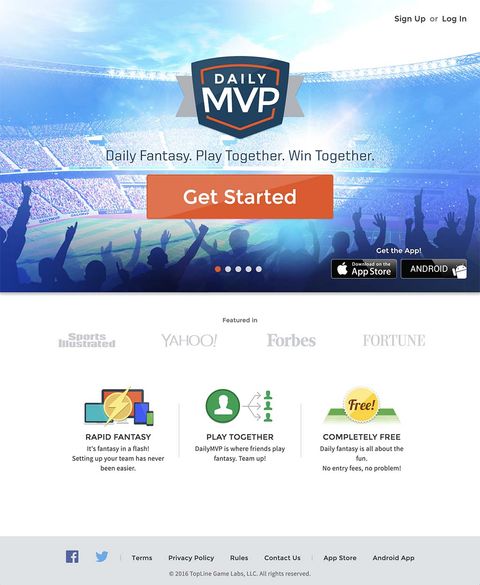
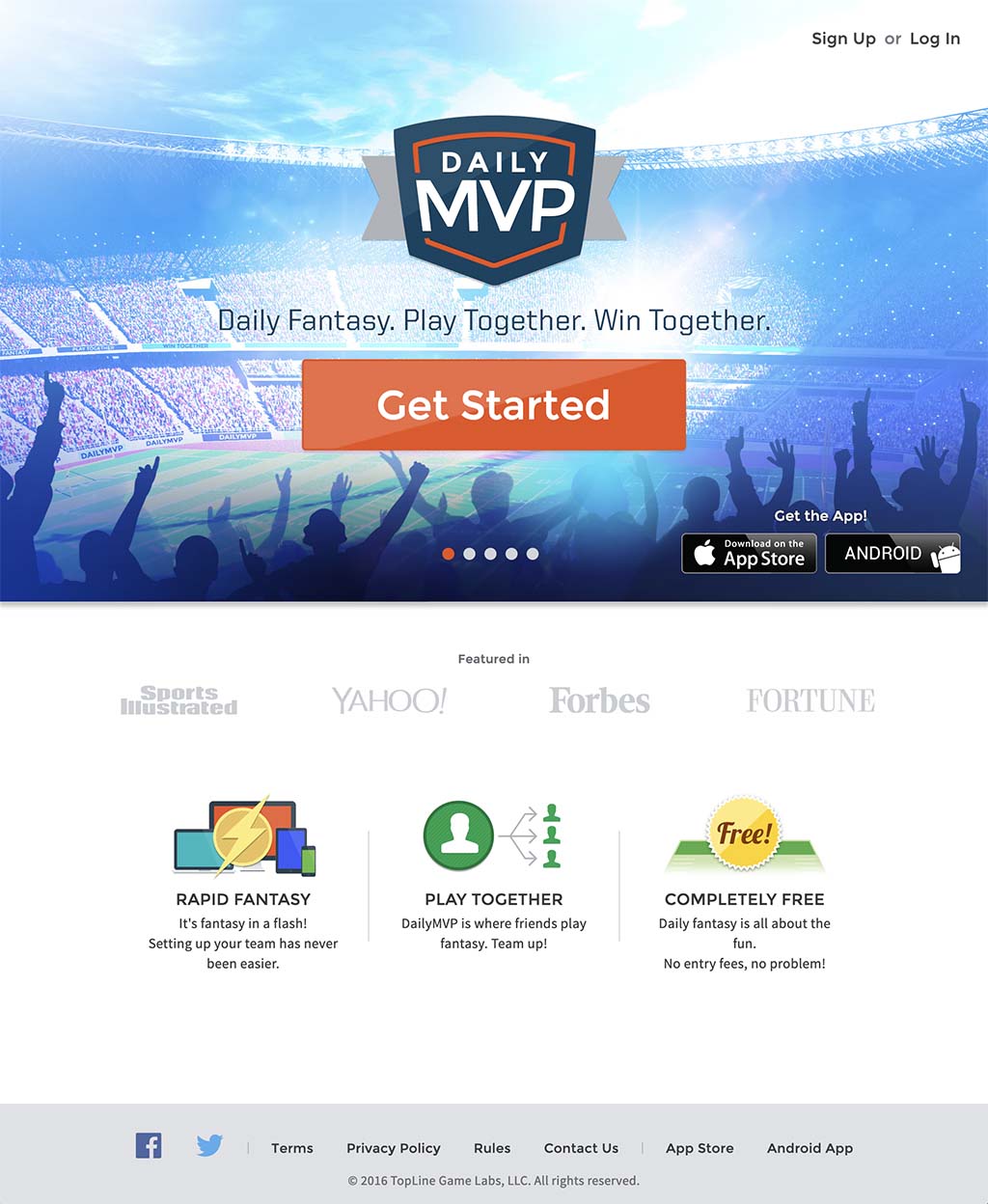
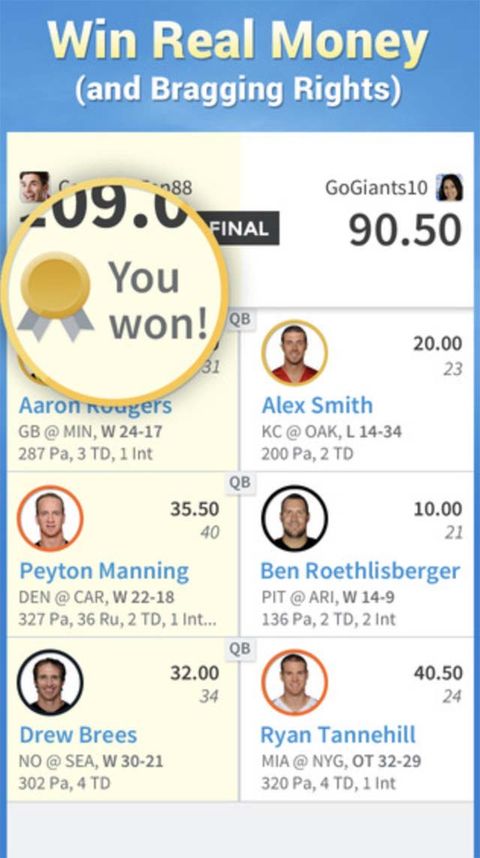
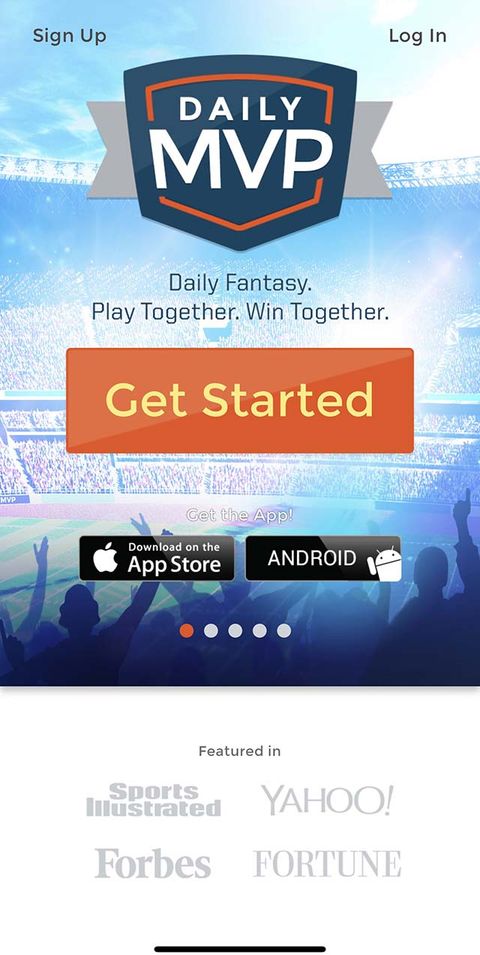
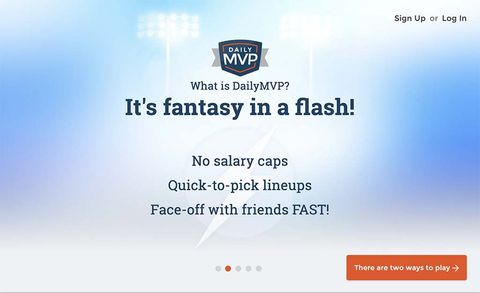
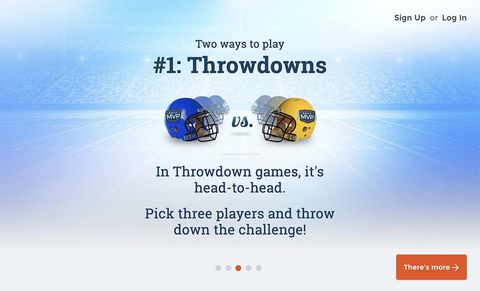
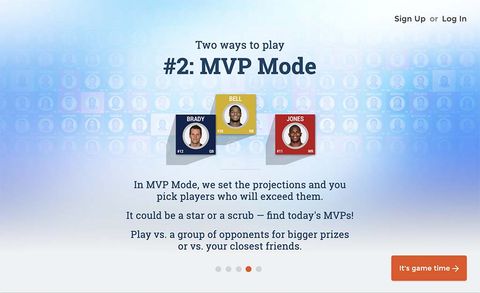
DailyMVP was a mobile-first daily fantasy sports platform positioned as a fast, casual alternative to the heavyweight salary-cap experiences at DraftKings and FanDuel. Where the dominant DFS platforms required deep research and complex roster optimization, DailyMVP built around head-to-head 1v1 matchups and simplified contest formats branded as QBSnap, Blitz, and FullHuddle — quick-play structures that ran continuously across the daily slates for the NFL, NBA, MLB, NHL, and Liga MX. Contests were per-game rather than daily-or-weekly, lowering the cognitive overhead for casual fans.
The product launched with both free-to-play and paid-entry contest pools, transitioning to 100% free-to-play in early 2016 as the daily-fantasy-sports regulatory environment shifted underneath the entire category. State attorneys general in New York and Nevada moved on the legality questions; the DraftKings and FanDuel ad blitz drew scrutiny that caught every player in the space; and Cantor Ventures, with its broader exposure to financial-services regulation, recalibrated its risk posture toward DailyMVP and the parent company.
The 2014 launch campaign starred Tom Brady and Steve Nash in the “Have an MVP Day” advertising — Brady and Nash in full-body disguises portraying ordinary “schmoes” who underwent transformations into extraordinary players. The Brady casting was notable for its time: he was historically selective about sponsorships, and shedding his suave high-fashion persona for the campaign — a shaggy wig and an excitable-office-telemarketer character — was a deliberate departure from the rest of his endorsement book. Live geo-fenced prize giveaways at games extended the campaign’s reach into the stadiums themselves.
The verifiable engineering numbers from the DailyMVP run:
- Concurrent peak: approximately 25,000 to 30,000 users during marquee events (Super Bowl Sunday, NFL opening weekend). The “hundreds of thousands of concurrent” figure that surfaced on the prior version of this case-study page was overstated; the corrected figure here is what the operations team actually measured at peak.
- Total registered users: approximately 100,000 across the lifecycle.
- Contest cadence: continuously active across single-day slates for all five major leagues, with per-game contest windows opening and closing on the game clock.
- Performance: no formal numbers retained, but the engineering posture was “fast” — the mobile-first web surface matched the native apps’ responsiveness, and the WebSocket fanout kept lineup scores updating live during play.
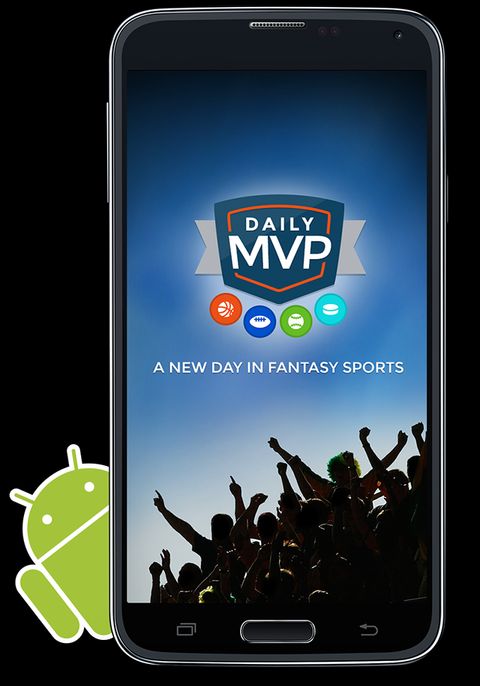
DailyMVP shipped on a single Angular 1 web codebase plus separate native iOS (Swift) and Android (Java) apps, with the web build serving full mobile-web parity. The architectural details — the Angular 1 + Less + Grunt stack, the Ruby + Faye-over-WebSockets real-time data tier, the Sportradar and STATS feed integrations, the AWS infrastructure shape — are covered in the next section.
FanNation — Sports Illustrated white-label
Mid-engagement, TopLine Game Labs landed a B2B partnership with Sports Illustrated to ship a casual-DFS product under SI’s brand. The product was FanNation at fannation.com — and rather than building a parallel codebase, the engineering team white-labeled the DailyMVP platform itself. Same Angular 1 frontend, same Ruby-Faye WebSocket layer, same Sportradar and STATS data feeds, same QBSnap-and-Blitz contest formats — wrapped in the Sports Illustrated visual identity (colors, logo, typography) without feature divergence underneath.
The arrangement structured FanNation as part of the TopLine Game Labs umbrella rather than a separate paid engagement — a showcase model that David Geller negotiated and managed directly on behalf of the entire parent company. The deal validated TopLine Game Labs’ platform-licensing thesis: the same architecture that ran DailyMVP could be licensed to enterprise sports brands without parallel maintenance. Forbes covered the partnership in the same November 2014 piece that placed DailyMVP in the broader DFS conversation.
For the engineering org the lift was modest — a branding skin layered onto the existing platform — but the strategic value was real. The same engineering discipline that ran the flagship product served the white-label without a duplicated codebase or duplicated operations team.

TopLine Game Labs corporate website
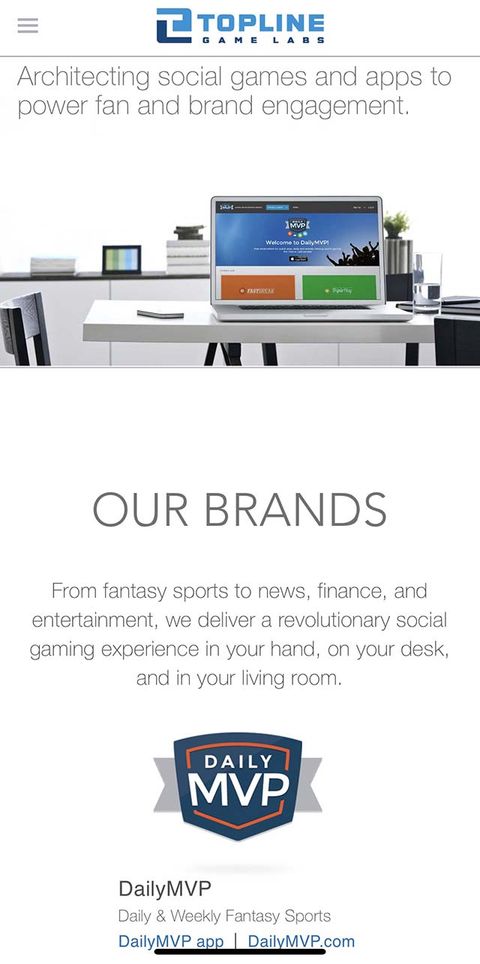
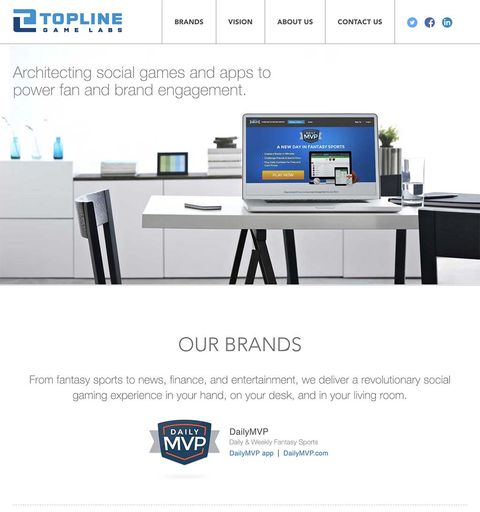
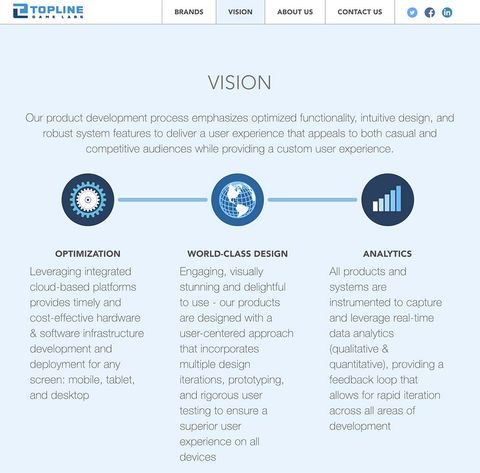
The third product was the TopLine Game Labs corporate marketing website at toplinegamelabs.com — the company’s own brand surface, separate from the gaming product but built by the same frontend team on the same release cadence. A fully-responsive corporate site shipped between mid-2014 and the engagement’s end in January 2016, used to surface the company’s leadership, the platform’s capabilities, and the SI/FanNation partnership.
It was scope-appropriately smaller than DailyMVP — a static-feeling marketing site rather than a real-time application — but its presence on the team’s docket reflected the founding-team operating model: one engineering org, multiple product surfaces, no contractor swap between them.
The architecture
The 2013-era technology choices read like a snapshot of the moment React was being announced. Angular 1 was Mike’s choice for the view layer — the dominant production-grade framework of the period, before the React ecosystem had settled or TypeScript adoption had crossed the consumer-web threshold. Less carried the CSS architecture. Grunt ran the build pipeline; Bower managed client-side packages; Jasmine plus Karma ran the test suites. TypeScript was still a niche choice in 2013 and didn’t enter the stack until later INNOV8 engagements.
State management was a hand-rolled publish-subscribe layer — Angular 1’s two-way binding plus a custom event bus that propagated WebSocket updates into the right components without leaking domain state through the view layer. The pubsub pattern Mike built on Angular 1 in 2013 was the right pattern for the framework available.
The real-time data architecture was the most architecturally interesting layer of the stack. Live sports data came from Sportradar as the primary feed, with STATS (now part of Stats Perform) providing supplementary play-by-play and player-tracking metrics. The backend ingested both feeds via a Ruby API + WebSocket tier, propagating updates to connected clients via Ruby Faye (a Bayeux-protocol implementation in Ruby) with long-polling fallback for older browsers and locked-down corporate networks. The fanout pattern that handled concurrency through Sunday-NFL-slate peaks was a separate backend/API team’s surface — the frontend’s job was to consume the WebSocket stream and propagate updates to the right view components without breaking the live-scoring UI under load.
The infrastructure ran on AWS with “hire-fire” autoscaling on the application tier and CloudFront as the CDN for static assets. The backend was built from scratch in Ruby — no third-party realtime SaaS, no off-the-shelf fantasy-sports engine. The frontend dictated the API shape and the release cadence, an unusual posture for a startup of this stage but one that reflected Mike’s role as a founding-team frontend lead rather than a downstream consumer of someone else’s API contract.
Native mobile was a separate two-engineer team — iOS in Swift, Android in Java, no cross-platform shim — built outside Mike’s remit but coordinated against the same backend contract. The web surface was built mobile-first with full parity to the native apps, which meant the same contest selectors, the same lineup-builder UI, the same live-scoring view, and the same payment flow worked at every breakpoint without falling back to a degraded mobile-web experience.
Engineering moments worth surfacing
The Facebook-friends rendering bypass. DailyMVP’s social-graph layer pulled in a player’s Facebook friends to
populate the head-to-head matchmaking surface — and Angular 1’s render lifecycle couldn’t handle the list at 1,000+
friends without hanging the browser. The framework’s digest cycle simply wasn’t built for that volume of bidirectional
binding. Mike wrote a bypass-render mechanism that built the list as a string and set innerHTML directly on the
target node, sidestepping Angular’s compile-and-link cycle entirely for the high-volume rendering path. The result took
the rendering ceiling from “hangs at 1,000 items” to clean rendering of 10,000+ items. The work taught a durable
lesson about framework escape-hatches: knowing when to step outside the framework’s idiomatic patterns is itself an
architectural skill.
The stats rules engine. The contest scoring logic — what counts as a fantasy point in QBSnap versus Blitz versus FullHuddle, how the head-to-head matchmaking resolves ties, how the geo-fenced live prize drawings fire — lived in a rules engine that consumed the live data feeds and emitted contest-scoring events to the frontend in real time. The engine was architecturally clean: data in, scoring decisions out, no domain logic leaking into the view layer. Mike still has the code; the architectural pattern aged well even where the framework choice did not.
The WebSocket fanout integration. Wiring an Angular 1 view layer to a Ruby-Faye long-polling-fallback transport under tens-of-thousands-of-concurrent-user load is not a problem you Stack-Overflow your way through in 2014. The team built the integration from scratch, learned where Faye’s reconnection semantics diverged from a “normal” WebSocket contract, and built the client-side reconnection-and-replay logic that kept lineup scores live through transient network drops without firing stale-state renders.
The wind-down
DailyMVP’s wind-down in early 2016 wasn’t an engineering failure or a market failure — it was a regulatory failure. The daily-fantasy-sports category had been operating in a legal gray area since its inception, classified as a “game of skill” rather than gambling. By late 2015 that classification was under direct attack from state attorneys general, most aggressively in New York and Nevada, with the DraftKings-and-FanDuel duopoly absorbing most of the public scrutiny but the entire category catching the spillover. Cantor Ventures — Cantor Fitzgerald’s venture arm, with the parent company’s broader exposure to financial-services regulation — pulled the DailyMVP investment as the regulatory risk crossed their threshold. The funding pull effectively ended the product.
The story didn’t end there. David Geller kept INNOV8 on through the wind-down period, transitioning the engagement into a separate Cantor-affiliated workstream: an AccuWeather-data-feed-based weather-derivatives futures-trading engine, codenamed AccuWeather internally, that became its own multi-year case study under the TradeWX engagement on this site. The thread from TopLine Game Labs’ wind-down to TradeWX’s launch is direct — same founder, same Cantor relationship, same trust in the work.
The bridge mattered. Founding-team engagements don’t end cleanly when the funding gets pulled; they extend into whatever the founder and the investor still want to build together. David Geller’s willingness to keep INNOV8 engaged through the DailyMVP wind-down, on a project his investor still cared about, is the credential the metrics don’t capture.
The people lineage
Two through-lines from TopLine Game Labs reach into the rest of the INNOV8 story.
The first is Jonathan Munsell, Mike’s first DailyMVP hire after a full year of searching for an engineer at the bar he set. Years later Mike brought Munsell onto the Kurrent cryptocurrency exchange engagement, where the same engineering discipline that handled live-scoring fanout for DailyMVP carried over to order-book rendering and trade-tape updates at exchange-scale. The Munsell relationship — like Mark Bieschke’s across the Honda + Acura arc, like David Geller’s across the TopLine Game Labs to TradeWX transition — is the kind of through-line that defines a 20+ year consulting practice. People who do good work together once tend to do good work together again.
The second is the Yahoo! pipeline itself. Mike’s Yahoo! Music tenure (LAUNCHcast rebuild, Grammy-night 500-million-page-request event-data infrastructure) was the credential that brought David Geller and Edwin Pankau to the founding-team interview, and the credential that produced Pankau’s “I LOVE HIM” note. The reputation built at one engagement compounds into the next; the operating model travels with it.
Today
TopLine Game Labs and DailyMVP haven’t existed as live products for ten years — the platform retired with the regulatory wind-down in January 2016, and the only remaining surface is the Web Archive snapshot linked from this page’s frontmatter. The engineering DNA from the engagement, on the other hand, never went away. The hand-rolled pubsub layer, the rules-engine architecture, the WebSocket-fanout discipline, the bypass-render escape-hatch instinct — all informed every INNOV8 engagement that came afterward, even when the framework choices changed underneath. The operator-receiver-receiver-of-trust pattern at the heart of the engagement — founders reaching out, the contractor relationship producing equity-aligned founding-team work, the trust extending through to the wind-down — is the same pattern that powers Phlip today.
The metrics page on this case study is short by design. Twenty-five thousand concurrent users at peak, one hundred thousand registered, three products under one team, four engineers including Mike at the team’s largest, two and a half years of founding-team execution. The Brady-and-Nash campaign is the marketing-layer credential. The Pankau recommendation is the people-layer credential. The bridge forward into TradeWX and Kurrent is the operating-model credential. Read them together; that’s the shape of what a founding-team frontend engagement actually produces.
Have something worth building together?
INNOV8 is currently focused on Phlip — but selectively open to the right next chapter. If the work here resonates with what you're trying to build, get in touch.